Laser cutting plastic to size
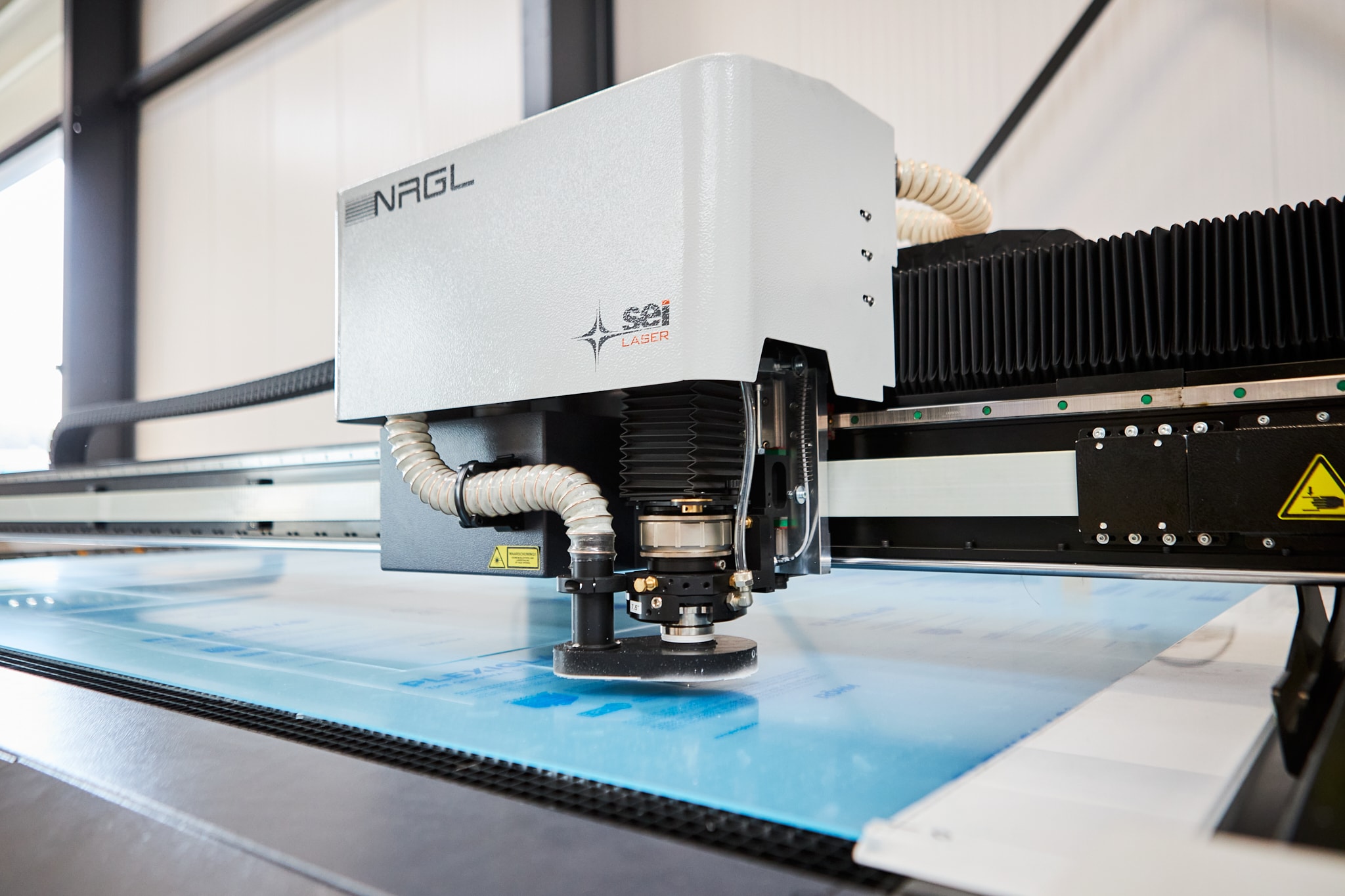
On this page we explain how we laser cut acrylic sheets to size in our own production facility in Wijster: which thicknesses we laser cut, how we handle your DXF file and what you can expect in terms of dimensional accuracy and the clear cut edge.
Which thicknesses do we laser cut?
We laser cut acrylic sheets up to and including 15 mm. Thicker acrylic sheets are milled or sawn. The table shows which process you get for each thickness and the smallest drill hole.
| Acrylic thickness | Process | Smallest drill hole |
|---|---|---|
| 2, 3, 4, 5, 6, 8 and 10 mm | Laser cutting | 3 mm |
| 12 mm | Laser cutting | 3 mm (GS) or 4 mm (XT) |
| 15 mm | Laser cutting | 4 mm |
| 20 mm | Milling | 4 mm |
| 25 and 30 mm | Straight sawing only | - |

How does laser cutting work?
With laser cutting, a laser beam cuts your part out of the sheet. We do this in our own production facility in Wijster. You choose a standard shape in the sheet calculator, like a circle, triangle or rounded rectangle, or you upload your own design as a DXF file. The laser reads the shape and cuts it out line by line.
From shape to part
The laser cuts exactly along the contour line of your shape, with an accuracy of ±0.05 mm. The laser beam is so narrow that the kerf stays within the dimensional tolerance of approx. 0.2 mm per cut edge. So your part comes out at the size you ordered.
What this means for your part
Laser cutting is contactless. No pressure is applied to the sheet, so your part doesn't deform during cutting. The heat of the laser melts the cut edge smooth: you get a clear edge, with no finishing needed. Sharp outer corners and fine details are possible. Inner corners do get a radius of at least 2 mm. This prevents stress at the corner and stops the sheet from breaking. You'll find the exact dimensions and tolerances below, under dimensions and finish.
Laser cutting or milling?
Which process we use depends on the material and the sheet thickness. We laser cut acrylic sheets up to and including 15 mm. We mill thicker acrylic sheets and all other materials.
Our drawing guidelines for professionals explain what your file needs to meet, so we can produce your part correctly.
Our drawing guidelines for professionals explain what your file needs to meet, so we can produce your part correctly.
Dimensions and finish
These are the specifications every laser cut part meets, whether you put it together in the sheet calculator or upload it as a DXF file. Here you'll find the dimensional accuracy, the minimum and maximum dimensions and what the cut edge looks like.
| Dimensions | |
|---|---|
| Laser accuracy | ±0.05 mm. |
| Dimensional tolerance | Approx. 0.2 mm per cut edge, up to approx. 0.4 mm across the full width or length. |
| Smallest shape | 50 × 50 mm. |
| Largest shape | The sheet size minus 2 cm. |
| Inner corners | Radius of at least 2 mm. This prevents stress at the corner and stops the sheet from breaking. |
| Outer corners and details | Sharp outer corners and fine details are possible. |
| Holes and cut-outs | Keep at least 2× the sheet thickness between a hole and the edge, and between two holes. |
| Finish | |
| Cut edge | Clear and smooth, thanks to the heat of the laser. No finishing needed. |
| Deformation | None. Laser cutting is contactless, so no pressure is applied to the sheet. |
| Not (yet) possible | Line engraving, surface engraving, countersinking, tapping and bevelled edges. |

Laser cutting acrylic
Other names:More information
These pages cover topics related to your order. They help you make the right choices and know what to expect in advance.

Ordering for your business
Find out why businesses order from us: our own production, careful packaging and fast delivery.

Milling to size
We mill thicker acrylic sheets and all other materials on our CNC milling machine. Read how it works and which materials and thicknesses we mill.