What is PVC?
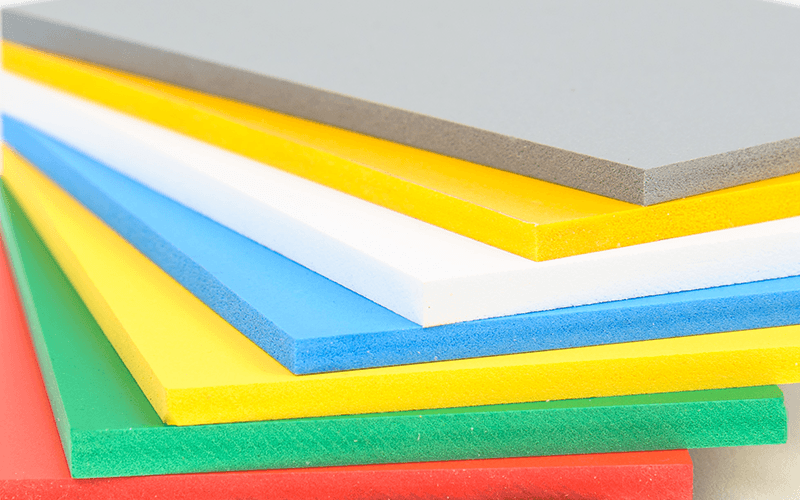

| Solid PVC | Foamed PVC | |
|---|---|---|
| Sheet type | Solid sheet | Solid top layers with foamed core |
| Impact-resistant | Yes | No |
| Machinability | Good | Good |
| Price | Inexpensive | Inexpensive |
| Total colours | 2 colours | 5+ colours |
| Sheet thickness (mm) | 2, 3, 4, 5, 6, 8, 10, 12, 15, 20 | 2, 3, 4, 5, 6, 8, 10, 13, 19 |
| UV-resistant | No | No |
| Damp-proof | Yes | Yes |
| Recyclable | Yes | Yes |
| Recycled | Yes | Yes (Foamed PVC ECO) |
| Type | Applications | Plasticisers | In our product range | |
|---|---|---|---|---|
| Unplasticised PVC (uPVC) | Solid strong form of PVC | Window frames, Cladding, Pipes | None | Yes |
| Plasticised PVC (pPVC) | Flexible and soft | Electric cables, Floors, Inflatable products | Yes | No |
| Chlorinated PVC (CPVC) | Higher temperature resistance and better mechanical properties | Hot water pipes, Industrial- pipe systems, Sprinkler systems | Yes | No |
| Molecularly Oriented PVC (PVC-O) | Molecularly oriented (stronger and tougher) | Water pipes, Pressure applications | None | No |
1
Polymerisation
The process starts with the polymerisation of vinyl chloride monomer (VCM) to form polyvinyl chloride (PVC) resin. The VCM is subjected to high pressure and temperatures to initiate the reaction, which is catalysed by a peroxide or other initiators. The polymerisation reaction results in the formation of powdered PVC resin.2
Mixing
The PVC resin is then mixed with various additives, such as stabilisers, lubricants and pigments. This improves its properties and performance. The additives are mixed with the PVC resin to form a homogeneous mixture.3
Extrusion
The PVC mixture is then fed into an extruder, a machine that melts the mixture and pushes it through a die to form a continuous profile. The profile can have different shapes and sizes, depending on the design specifications.4
Cooling
The extruded profile is cooled by passing it through a water bath or air cooling system to solidify it and maintain its shape5
Cutting and finishing
The cooled profile is then cut to the desired length and finished according to specific application requirements, such as drilling holes, welding or gluing.
Colours
Solid PVC
- Possible
- Drilling
- Glueing
- Milling
- Sawing (circular saw)
- Not possible
- Bending (cold)
- Coating
- Engraving
- Lasering
Foamed PVC
- Possible
- Cutting
- Drilling
- Glueing
- Milling
- Not possible
- Bending (cold)
- Coating
- Lasering
- Polishing
Frequently asked questions

Share this article
Updated:
Published: